Check Engine Light On? What a Real Diagnostic Looks Like (Hint: It’s Not Just Reading the Code)
That little amber light on your dashboard has a way of ruining an otherwise ordinary Tuesday. It might come on during the drive home from work, or it might greet you first thing in the morning. Either way, the question is the same: what’s actually wrong?
Plenty of drivers assume the answer comes out of a scanner. Plug in a tool, read the code, replace the part it names. That is how a lot of money gets wasted on repairs that don’t fix anything.
A real diagnostic is a process, not a readout. Here is what it looks like when it’s done properly, and why that process matters for drivers in Avondale and around the West Valley.
The Code Is a Clue, Not a Verdict
Start with what a trouble code actually is. Modern vehicles monitor themselves constantly, and when a sensor reads outside its expected range, the computer stores a code like P0420 or P0171 and turns on the light.
The code tells you which circuit or system flagged the problem. It does not tell you which part failed, or why. P0171, for example, means the engine is running lean, meaning too much air relative to fuel. The fix could be a vacuum hose, a dirty mass airflow sensor, a weak fuel pump, or a dozen other things. The code is the starting point of the investigation, the same way a fever tells a doctor that something is wrong without saying what.
That distinction matters because parts are expensive. Swapping components until the light goes away can cost more than the repair ever should have, and the light often comes back anyway because the actual fault is still in place.
Step One: Listening to You
Before anything gets plugged in, a good technician asks questions. This step gets skipped more than you’d think, and it’s the cheapest diagnostic tool there is.
When did the light come on? Was the engine cold or warm? Does the car feel different, hesitating at a stoplight, idling rough, using more fuel than usual? Did it happen after a fill-up, a long highway drive, or a dusty monsoon commute?
Those answers narrow the search dramatically. A rough idle that disappears when the engine warms up points somewhere entirely different than a misfire that shows up under load. Your observations are real data, and they shape everything that follows.

Step Two: Reading the Codes and the Freeze Data
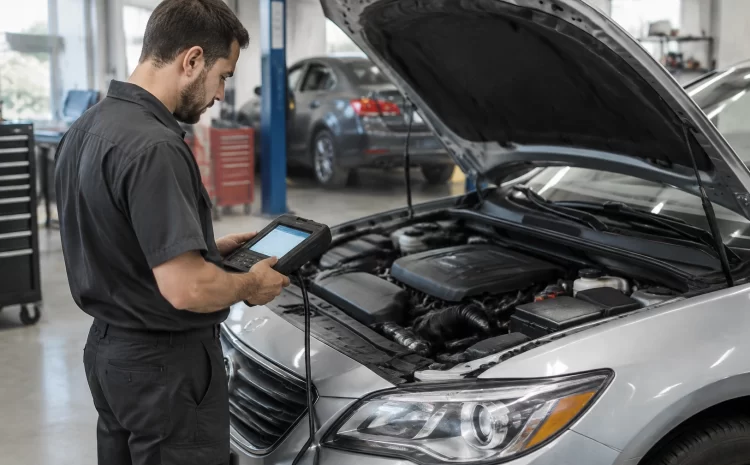
With the story in hand, the scan tool connects to the vehicle’s onboard diagnostics port, usually under the dash. Professional-grade tools pull more than the basic code. They retrieve freeze frame data, a snapshot of what the engine was doing at the exact moment the fault set: engine speed, load, coolant temperature, fuel trims.
A code that sets at idle means something different than the same code setting at 65 miles per hour. Freeze frame data shows which scenario you’re dealing with, and that context alone eliminates half the possible causes before a single part is touched.
The technician also checks for pending codes and history codes. Some faults set the light, clear it, and set it again weeks later. Seeing the full pattern matters.
Step Three: Live Data and the Hands-On Tests
This is where a real diagnostic separates itself from a parts-store code read. The scan tool goes into live data mode and watches the sensors while the engine runs.
Fuel trims show whether the computer is compensating for a lean or rich condition and by how much. Sensor readings get compared against each other and against what the spec says they should be. A single sensor that disagrees with its neighbors is a suspect. So is a sensor that reads perfectly but never changes, which usually points to a circuit problem rather than a bad part.
Then come the physical tests. Voltage and resistance get measured with a multimeter at connectors and grounds, because a corroded wire can mimic a failed sensor exactly. Vacuum lines get checked, smoke tests can find tiny intake leaks, and components get exercised directly. A capable scan tool can command a solenoid on and off, cycle a purge valve, or run an injector balance test and watch what the engine does in response.
This is the difference between reading the patient’s chart and actually examining the patient.
Step Four: Confirming the Cause Before Replacing Anything
By this point the technician has a short list, and the final step is confirmation. The suspected component gets tested against its specification. Wires get wiggled with the circuit loaded. The connector gets inspected for corrosion or a loose pin.
Only when a cause is proven does the repair recommendation get made. And that recommendation should come with an explanation you can follow: what failed, what it caused, what it did not cause. If a shop tells you a part needs replacing but can’t explain the evidence behind it, that’s a reasonable moment to ask for the test results.
It’s also worth saying what a proper diagnostic does for you on price. Up-front, it converts a mystery into a defined repair with a known scope. At our shop, quotes are given before work begins, and the same standard applies to mobile diagnostics performed in your driveway around the West Valley as it does to a bay visit.
Step Five: The Repair and the Road Test
The light going off isn’t the finish line. After the repair, the technician verifies the fix: the readiness monitors get checked, fuel trims return to normal, and the car goes on a road test that reproduces the original conditions from the freeze frame data.
If the condition that set the code originally doesn’t return, the repair holds. If it does, you want to know before the invoice is final, not three weeks later. Every job we do carries a 12-month warranty for exactly that reason.
Why All This Effort Is Worth It
Here’s the practical payoff. Cars today run a dozen systems that interact with each other, from fuel delivery to emissions to ignition timing. A fault in one of them can ripple into the others, and chasing symptoms system by system is how small repairs become big ones.
A real diagnostic follows the fault to its source the first time. That protects your budget and your schedule, and it’s the honest way to work. When your check engine light comes on, you don’t need someone to read the code to you. You need someone to find out why it’s on.
Mobile Man Auto Repair has been taking care of Valley drivers since 1999, with more than 35 years of combined experience under our belts. Whether you need car diagnostics near you in Avondale, AZ or anywhere our mobile service reaches throughout the West Valley, we’ll trace the problem to its cause and explain what we found in plain language. Hablamos español, and every repair is backed by a 12-month warranty.
Call us at 623-936-5580 when that light comes on. We’ll find out what your car is actually trying to tell you.