Left Your Car Sitting All Summer? A Snowbird’s Guide to Waking It Up Safely
As September turns to October, many West Valley snowbirds are returning to vehicles that have spent the summer parked in an Arizona driveway, garage, or carport. After several months of intense heat and almost no use, your car may look ready to go, but that does not mean it is safe to start and drive straight to the freeway.
A parked vehicle can develop several problems at once. The battery may be dead or sulfated, the fuel may be stale, the tires may have flat spots, and the brake rotors may have developed surface rust. Rodents may have chewed wiring, while heat-sensitive fluids, belts, hoses, and air-conditioning components may need attention.
Treat the first start like a careful inspection, not a quick test. A few extra steps can help prevent a breakdown, tire failure, brake problem, or overheating issue during your first trip back on the road.
Why Arizona Storage Is Hard on Your Vehicle
A car that sits unused does not escape wear. In some ways, storage creates its own problems.
Arizona heat accelerates battery deterioration, dries out rubber components, increases tire aging, and puts stress on cooling and air-conditioning systems. Months of sitting also allow moisture, dust, corrosion, and pests to create problems that may not be obvious from the driver’s seat.
The Arizona Department of Transportation recommends checking key systems such as the battery, A/C, coolant, fuel level, and tire pressure before driving in extreme heat. Those same checks are important when you are bringing a stored car back into regular use.
Start With a Walkaround: Before You Turn the Key
Begin in daylight with the engine off. Look underneath the car for fresh or dried stains. Oil, coolant, brake fluid, transmission fluid, or gasoline leaks all require attention before driving.
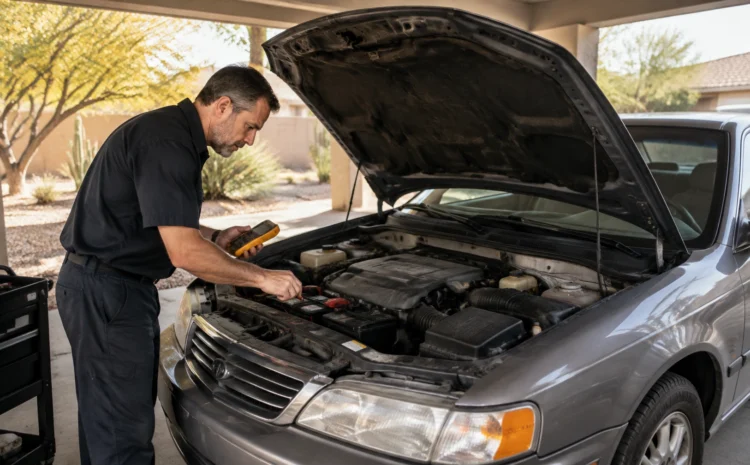
Then open the hood and inspect the engine compartment carefully. Look for:
- Rodent nests or shredded material
- Chewed wiring or damaged insulation
- Debris in the air intake
- Cracked belts or hoses
- Corrosion around battery terminals
- Dried coolant residue near hoses, the radiator, or the water pump
Also check the cabin and trunk. Droppings, unusual odors, shredded paper, or food remnants may indicate that rodents entered the vehicle. A damaged wire can affect starting, charging, fuel delivery, lights, or safety systems.
If you find extensive rodent damage, do not keep trying to start the car. A technician should inspect the wiring and surrounding components first.
Check the Battery Before Assuming a Jump Start Will Fix It
A battery that has been sitting for months may be completely discharged. More importantly, it may be sulfated. Sulfation occurs when lead sulfate crystals build up inside a battery that remains discharged for an extended period. The result is a battery that may accept a temporary jump but cannot reliably hold a charge.
Check for swollen or cracked battery cases, leaking fluid, loose connections, and heavy corrosion. If the battery looks damaged, do not attempt to jump it.
Even if the engine starts with a jump, the battery and charging system should be tested. A proper test can help determine whether you need a battery replacement, an alternator inspection, or both. Repeatedly jumping a weak battery can leave you stranded at the next stop.
Inspect Tires for Pressure Loss and Flat Spots
Tires lose pressure while a vehicle sits. They can also develop temporary or permanent flat spots where the rubber rests on the ground for an extended period.
Before moving the vehicle, check all four tires and the spare. Look for:
- Low pressure
- Sidewall cracks
- Bulges
- Uneven wear
- Dry rot
- Tread damage
- Severe flat spots
Set the pressure according to the vehicle manufacturer’s door-jamb label, not the maximum pressure printed on the tire. If a tire is visibly damaged or badly underinflated, do not drive on it.
Mild flat spotting may improve as the tires warm and flex during a short, slow drive. A strong vibration, steering-wheel shake, or persistent thumping means the tires need professional inspection before highway travel.
Be Careful With Stale Fuel
Gasoline degrades over time, especially when a vehicle sits for months without fuel stabilizer. The fuel may lose some of its volatility, and deposits can affect injectors, fuel pumps, and engine performance.
If the fuel level is very low, add fresh gasoline before attempting much driving. If the tank is partly full, fresh fuel can help dilute older gasoline, but do not assume that dilution will solve every problem.
After starting, pay attention to hard starting, rough idle, hesitation, stalling, or a check-engine light. Continued symptoms may point to degraded fuel, restricted fuel delivery, injector problems, or another issue that requires diagnostics.
Diesel vehicles and heavy-duty trucks may need additional fuel-system checks, particularly if condensation or contamination is suspected.
Expect Some Rust on the Brake Rotors
Light surface rust on brake rotors is common after a vehicle sits. You may hear a brief scraping sound during the first few stops as the brake pads clean the rotor surface.
That does not mean every stored car is ready for normal driving. Before moving, press the brake pedal several times. It should feel firm and consistent. A soft, spongy, or sinking pedal is a reason not to drive.
During a slow test drive, watch for:
- Grinding that does not go away
- Severe scraping
- Pulling to one side
- Brake-pedal pulsation
- Poor stopping performance
- A burning smell
Deeper corrosion can damage the rotor and reduce braking performance. A brake inspection can determine whether cleaning is sufficient or whether pads, rotors, calipers, or brake fluid need attention. You can also review common brake problems and how to address them for more warning signs.

Check Fluids, Belts, and Hoses
Do not open a hot radiator cap, but once the engine is cold, check the coolant reservoir. Look for a low level, discoloration, oily residue, or dried coolant around the engine bay.
Also check:
- Engine oil level and condition
- Brake fluid level and color
- Transmission fluid, if your vehicle has a serviceable dipstick
- Power-steering fluid, if applicable
- Windshield washer fluid
- Visible leaks around fluid reservoirs and lines
Fluids do not all fail in the same way. Engine oil can collect condensation, brake fluid can absorb moisture and become dark, and coolant can become contaminated or leak away. A fluid that looks separated, unusually cloudy, burnt, or gritty deserves professional evaluation rather than a simple top-off.
If the car was due for an oil change before you left, schedule that service before a long drive. You can also review general maintenance services from Mobile Man Auto Repair for a broader inspection.
Test the A/C Before You Need It
After an Arizona summer, the air conditioner deserves special attention. Turn it on while the vehicle idles and confirm that it produces genuinely cold air. Check whether the blower works at every speed and listen for unusual compressor, belt, or fan noises.
If the air is only slightly cool or remains warm, the system may have a low refrigerant charge caused by a leak. Refrigerant does not normally disappear simply because the vehicle sat; a low charge usually means the system needs leak testing and proper service.
Do not rely on a quick refrigerant refill without finding the cause. A leak, damaged hose, condenser, compressor, or electrical fault may leave you with warm air again soon.
Do Not Jump It and Drive Straight to the Freeway
The most important rule is simple: a successful start does not prove that the vehicle is road-ready.
A jump-start only supplies enough power to crank the engine. It does not confirm that the battery will keep working, the alternator is charging correctly, the tires are safe, the brakes will stop the vehicle, the cooling system is leak-free, or the wiring is undamaged.
Instead, let the engine idle briefly while you watch the temperature gauge and warning lights. Listen for unusual knocking, squealing, ticking, or harsh vibration. Look underneath for fresh leaks.
If everything appears normal, begin with a short, low-speed test drive close to home. Test the brakes gently, check steering response, and pay attention to vibration, pulling, warning lights, and temperature. Do not take the freeway until the vehicle has passed these basic checks.
For a more complete evaluation, auto diagnostics and inspections can help identify problems that are not obvious during a visual check.
A Mobile Inspection Can Save You a Risky First Trip
You do not always need to arrange a tow or drive an uncertain vehicle to a shop. A mobile auto repair service can come to your driveway or carport and handle many of the first-start checks where the vehicle is parked.
Mobile Man Auto Repair can help drivers in Avondale and throughout the West Valley with services such as:
- Battery testing and replacement
- Starting and charging-system checks
- Brake inspections and repairs
- Tire and fluid inspections
- Diagnostic testing
- Wiring and rodent-damage evaluation
- A/C diagnosis
- General maintenance and safety inspections
Some repairs can be completed on the spot. If the vehicle needs equipment or repairs that require a full shop, Mobile Man also has a physical facility at 519 W. Western Ave. in Avondale.
Whether you search for a “mobile mechanic near me” or need dependable auto repair in Avondale, AZ, having a technician come to the vehicle can be more convenient, and safer, than gambling on an untested drive.
Wake Your Car Up Carefully
Your snowbird vehicle may only need a battery and a short inspection, or it may need attention in several systems after months in the heat. The key is to find out before you depend on it for errands, family trips, or a freeway commute.
Inspect the vehicle, check the battery and tires, verify the fluids, test the brakes, look for rodent damage, and confirm that the A/C and cooling system work properly. If you would rather have a professional handle the process, request an appointment with Mobile Man Auto Repair or call 623-936-5580.
Mobile Man Auto Repair is a family-owned shop serving the Valley since 1999, with in-shop and mobile services, Spanish-speaking assistance, fair pricing, and 12-month warranties on all work.